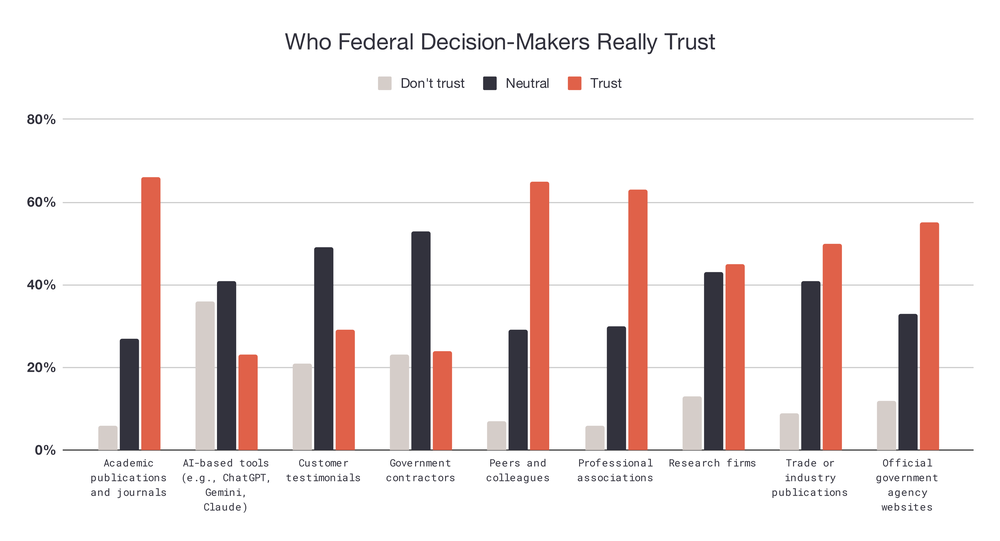
There's a common thread here. Each of these sources is seen as independent. Academic research goes through peer review. A colleague at another agency has no quota to hit. A professional association exists to serve its members, not to sell to them. They offer distance from the sales pitch.
Federal decision makers are accountable for how they spend taxpayer dollars. It makes sense that they lean on sources with no obvious stake in the outcome.
Which information sources rank lowest in trust?
AI tools and government contractors ranked near the bottom of the sources measured.
But that ranking needs a little context. Our research on federal buyers and AI-generated content has shown that buyers can use AI while still questioning its answers. A lower trust ranking doesn’t mean a source goes unused.
If you work in B2G marketing, that's a tough finding to read. But don't close the tab just yet.
Does low trust mean federal buyers distrust contractors?
Here's where it gets interesting. Only 7% of respondents said they distrust government contractors as information sources. Most were neutral.
That’s an important distinction. A neutral response doesn’t tell us whether someone has limited experience, mixed impressions, or simply needs more evidence. And a rating of contractors as a group doesn’t tell you how buyers see your particular company.
So I wouldn’t read this as a reason to give up on contractor content. I’d read it as a reason to give buyers more to go on.
How can B2G marketers build trust with federal buyers?
Start by contributing to the places buyers already trust and making your claims easier to verify. Here are four ways to do that.
- Get your experts into trade publications.
Trade and industry publications give your subject matter experts a platform buyers already read. Bylined articles, expert commentary, and interviews put your thinking in front of the right audience, with the added credibility of an editorial setting.
Lead with insight, not pitch. The goal is for a reader to finish the piece thinking, "These people understand my problem."
- Show up at association events.
Professional associations are among the most trusted sources on the list, and their events are where your audience gathers to learn from one another.
Sponsor a session, contribute a speaker, or simply be a consistent, helpful presence. Over time, you become part of the community instead of someone selling to it.
- Back your claims with independent research.
Every company says its solution is fast, secure, and cost-effective. Federal decision-makers have heard it all. What sets you apart is evidence they don't have to take on faith: third-party research, independent assessments, and data from credible sources.
When your claims line up with what a neutral party found, buyers have a reason to listen.
- Make your customers’ experience easier to share.
You can’t script a conversation between two program managers, but you can give your customers something worth talking about.
Deliver on your commitments. Work with customers on approved case studies that explain the problem, what changed, and how the results were measured. Make those stories easy for someone to pass along to a colleague facing a similar challenge.
Give buyers a reason to believe you
Federal decision makers aren't against you. Most of them simply haven't decided about you yet. That's an opportunity, but only if you meet buyers in the places they already trust, with content that earns their attention instead of demanding it.
Your brand messaging matters. It's just far more powerful when it's echoed by sources feds already believe.
Want more data on how federal decision-makers research, evaluate, and choose partners? Visit the GovExec Resource Hub for more insights and toolkits.
 4 minutes