5 minutes
Every contractor has an idea of how the federal market sees their company, but it might not be accurate.
Internal teams know the relationships they’ve built, the capabilities they’ve delivered, and the reputation they believe they’ve earned. But federal employees are forming their own impressions, and the gap between those two views can create a blind spot.
You may believe your company is known for a specific set of expertise. Federal stakeholders may see a different set of strengths. They may also see weaknesses your organization has underestimated or competitors have already learned how to exploit.
The latest data from our semi-annual GovExec Reputation Index, based on feedback from more than 1,000 federal employees across civilian and defense agencies, gives contractors a current view of where they stand.
The study measures more than 60 companies to show who federal stakeholders know, who they favor, and what is driving those perceptions. Looking across the field can also reveal where an organization stands apart and where another company may hold an advantage.
What’s the Difference Between Brand and Reputation in GovCon?
Our research looks at two distinct dimensions of federal perception:
- What they associate with the experience of working with a company.
- What they believe about the company itself.
Brand answers the question, “What is it like to work with you?”
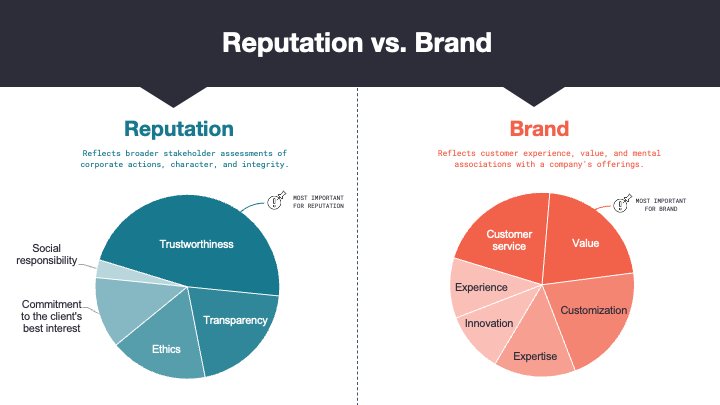
Traditional brand studies often focus heavily on awareness and topline favorability. In the Reputation Index, we also look at the attributes behind those perceptions. Of the brand attributes we measured — experience, expertise, value, customer service, innovation, and customization — federal respondents ranked value and customer service as most important.
Brand, in this context, is closely tied to the experience of working with a company. How responsive are you? How much value do you deliver? Does your organization bring the right expertise? Can you customize to a program’s needs?
Reputation answers a different question: “What kind of organization are you?”
It's less about a single transaction and more about character — trustworthiness, ethical business practices, transparency in decision-making, social responsibility, and commitment to the client's best interest. Trustworthiness topped the list as the single most important reputation driver.
In other words, brand helps us understand how the market experiences and evaluates what a company delivers. Reputation is what stakeholders believe about the organization itself.
A contracting officer or program manager may experience your brand directly. But reputation reaches further, into the political and non-technical influencers who influence a decision without ever touching your product, such as:
- Communications teams
- Public affairs offices
- Oversight bodies
- Other stakeholders who judge your organization from the outside in
That also means two companies pursuing the same customer can enter the conversation with varying advantages.
One may be known for expertise, innovation, and strong customer experience but face questions about trust or transparency. Another may have an excellent corporate reputation but not stand out clearly on the capabilities buyers value most.
Looking at both gives contractors a better picture of where they have an advantage, where competitors may be leading, and what buyers still need to believe about them.