Show the Solution, THEN the Seller
Federal decision-makers want to understand how work gets done.
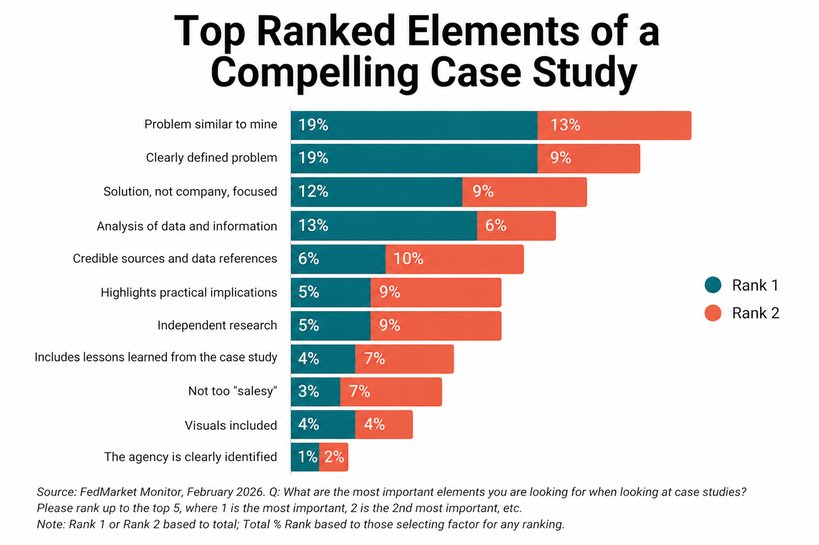
Twelve percent of respondents ranked "the case study focuses on the solution to a problem, not the company providing the solution" as their top element.
Three percent labeled "case study is not too salesy" as critical.
Focus on your approach, implementation model, technical execution, stakeholder coordination, and measurable outcomes.
Use plain language. Explain what changed because you were involved.
Whenever possible, quantify impact:
- Cost savings
- Reduced processing time
- Faster deployment timelines
- Error reduction rates
- Improved citizen experience
- Greater operational resilience
Numbers, not logos, create credibility. Specificity creates trust.
Add Data, Rigor, and Independent Validation
Government buyers make consequential decisions. They respond to evidence.
Thirteen percent of respondents ranked "a thorough analysis of the data and information gathered" as their top factor.
Six percent prioritized "references to credible sources and data."
While these are not large numbers, they do suggest that federal decision-makers want rigor (a finding that has echoed across our research projects). They're making significant procurement decisions, and they need to trust what they're reading.
If your story involves AI, automation, cybersecurity, cloud migration, or modernization, move beyond feature descriptions.
Show:
- The baseline condition
- What changed
- How it was measured
- Why the outcome mattered
Third-party validation, benchmark data, or agency metrics can materially strengthen the story and set you apart.
Make It Easy to Share Internally
Case studies rarely stay with one reader.
They move across program offices, acquisition teams, leadership chains, internal advocates, budget justifications, and procurement conversations. That means usability matters as much as content.
Seven percent of respondents ranked "case study formatted in a way that is easily shareable with colleagues" as a top factor.
Use a clean structure:
- Concise executive summary with practical implications and findings
- Problem statement
- Approach
- Results
- Lessons learned
A clear, readable asset has a better chance of traveling inside an organization.
Don't Forget the Visual Layer
Charts, timelines, workflows, and before-and-after comparisons help busy readers quickly process value.
Our data shows that while visuals ranked lower overall, they serve a functional purpose when illustrating timelines, technical architecture, or performance impact. A well-designed chart showing a 40% reduction in processing time says more than two paragraphs trying to explain it.
When showcasing new technology adoption, visuals can also help demystify complex implementations – especially when your audience includes program managers or contracting officers who may not have a deep technical background.
Making the Case
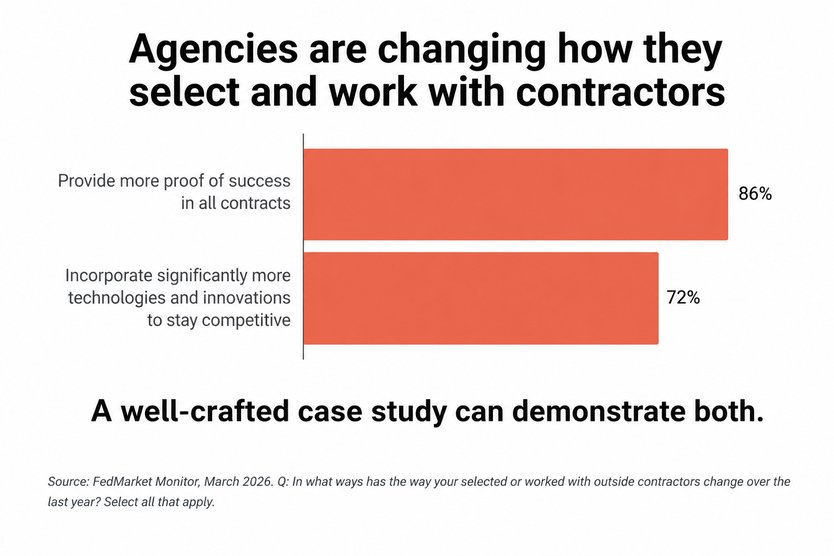
Federal buyers are clear about what they need: prove you understand problems like theirs, show a rigorous and solution-focused approach, back it with data, and make it easy to share. The contractors who do this well will make a bigger impact – and they'll build the kind of credibility that outlasts any single contract.
Learn more about GovExec Intelligence.
Need help crafting the perfect case study? Reach out today.
Data sourced from Fed Market Monitor, February and March 2026. Survey responses from federal decision makers.
 4 minutes