How Contractors Can Prove Value Amid the Federal Workforce Crunch
3 minutes

How Contractors Can Prove Value Amid the Federal Workforce Crunch

By Susan Rose, Vice President of Strategic Marketing and Advisory Services

May 27, 2026

Between evolving mission requirements and a turbulent talent landscape, federal leaders are facing a dual crisis of capacity and capability. For B2G marketing and sales teams, this presents an opportunity to show empathy while demonstrating value.

How? By speaking directly to the operational pain points that keep federal decision makers up at night. The latest data from the April 2026 Fed Market Monitor survey results provide a roadmap of where those pain points lie.

Here is a breakdown of what the data tells us about the current federal workforce climate and how you can position your solutions to drive maximum impact.

The Reality on the Ground: Staffing and Expertise Gaps

The numbers paint a clear picture of federal sentiment regarding workforce readiness.

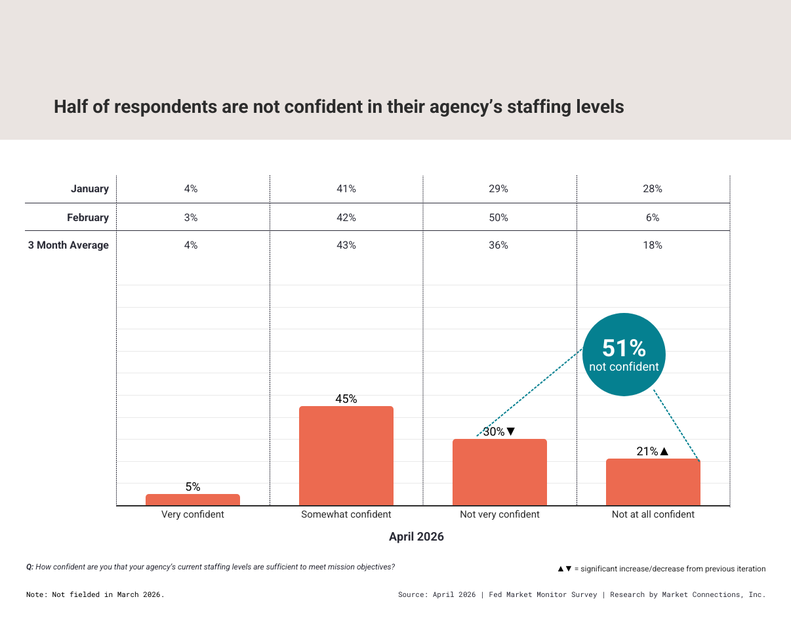
  • The Staffing Deficit: Half of federal respondents report they are not confident their agency’s current staffing levels are sufficient to meet mission objectives. Alarmingly, the segment of respondents who are "not at all confident" spiked significantly to 21% in April, up from just 6% in February.
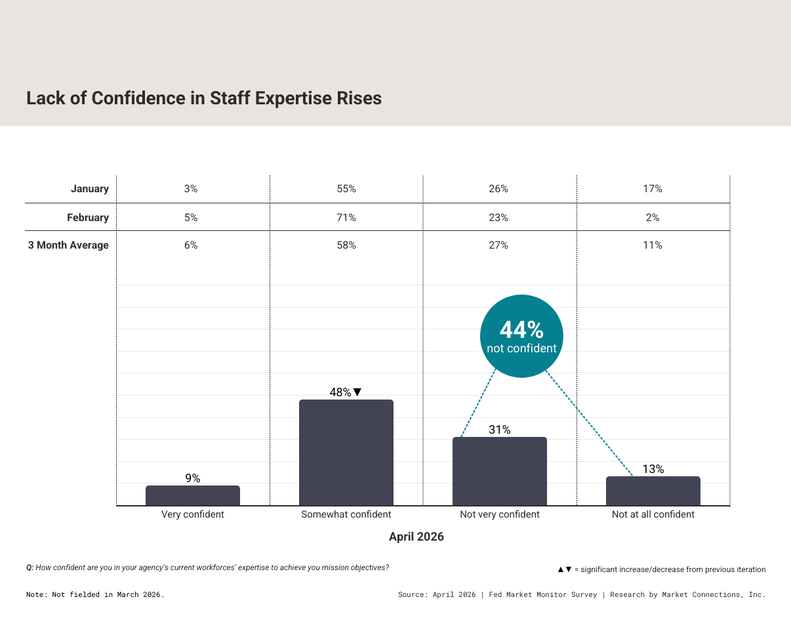
  • The Expertise Erosion: Confidence in workforce expertise is also slipping. While 57% remain at least somewhat confident, positive sentiments dropped significantly. This decline was largely driven by a sharp drop in those feeling "somewhat confident," which fell to a 2026 low of 48% (down from 71% in February). A little more than one in three are not at all confident in their staff’s expertise.

The Takeaway for B2G: Federal teams are stretched thin and acutely aware they may not have the headcount or specialized skills needed to hit their goals.

Realigning Workforce Priorities

When asked where the federal government should focus its workforce efforts over the next six months, the priorities shifted heavily toward preservation, modernization, and restructuring.

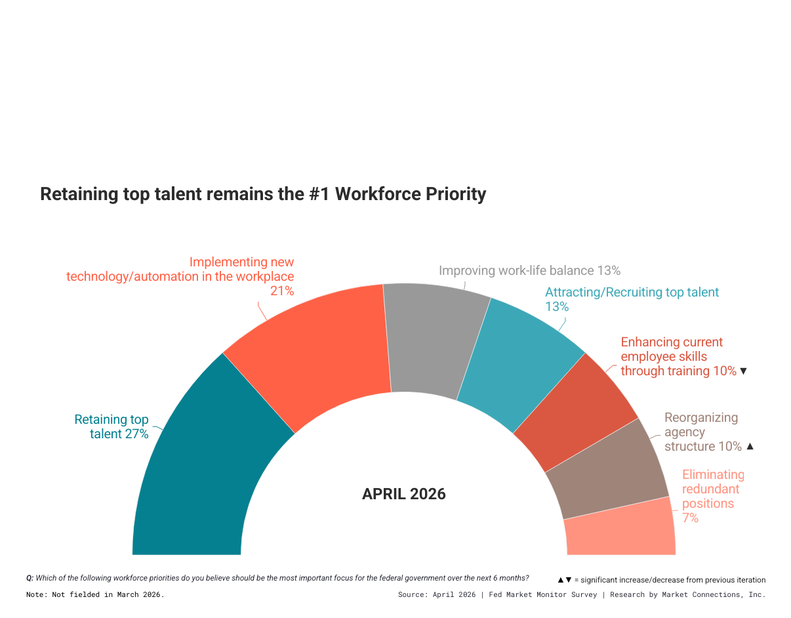
  • Retaining Talent is Paramount: "Retaining top talent" reclaimed the number one spot at 27%.
  • The Tech Surge: "Implementing new technology/automation" saw a massive jump, rising to 21% in April from 17% in February and just 12% in January.
  • Structural Realignment: "Reorganizing agency structure" increased significantly, rising to 10% in April from a baseline of just 3% in previous months. Conversely, "enhancing current employee skills through training" plummeted from 29% in February to just 10% in April.

Pivot Messaging from Features to Force Multipliers

With agencies looking to technology and structural reorganization to solve their talent gaps, B2G marketers must align their value propositions accordingly. Focus on capacity over products.

1. Frame technology as a retention tool.

Since retention is the top priority, position your solutions as a way to eliminate burnout work. When agencies implement smart solutions, they offload tedious, administrative tasks. This allows their remaining top talent to focus on high-value, mission-critical work, which directly improves job satisfaction and retention.

  • Core Message: "Empower your best people to focus on the mission, not the paperwork."

2. Position solutions as immediate.

With confidence in workforce expertise dropping, agencies don't have the luxury of waiting for long training pipelines, which explains why training priorities have fallen. Position your offerings (especially managed services or intuitive SaaS platforms) as immediate bridges to plug the capability gap.

  • Core Message: "Instantly scale your agency's technical capabilities without the hiring or training lag."

3. Support the structural reorg.

With more leaders eyeing agency reorganization, position your advisory services, IT modernization tools, or consulting frameworks as the scaffolding that makes restructuring seamless and low-risk.

  • Core Message: "Minimize operational downtime and optimize workflows during critical agency realignments."

Proof That Sticks

Federal buyers are inherently risk-averse, especially when understaffed. To back up these messages, sales and marketing teams can lead with specific, practical proof points:

  • Time-to-Value Metrics: Show exactly how quickly your solution can be deployed to relieve an overburdened team.
  • Hours Reclaimed: Use case studies to demonstrate how your automation tools saved a specific number of labor hours, effectively acting as digital FTEs to offset the 50% staffing confidence deficit.

(Read What Federal Buyers Want From Case Studies in 2026)

  • Ease of Adoption: Prove that your platform requires minimal training, directly answering the market’s pivot away from heavy training burdens.

Anchor your strategy in this data to prove you are an indispensable strategic partner helping federal leaders survive the workforce crunch.

Connect with our team for more data-backed strategies.

More to Read >