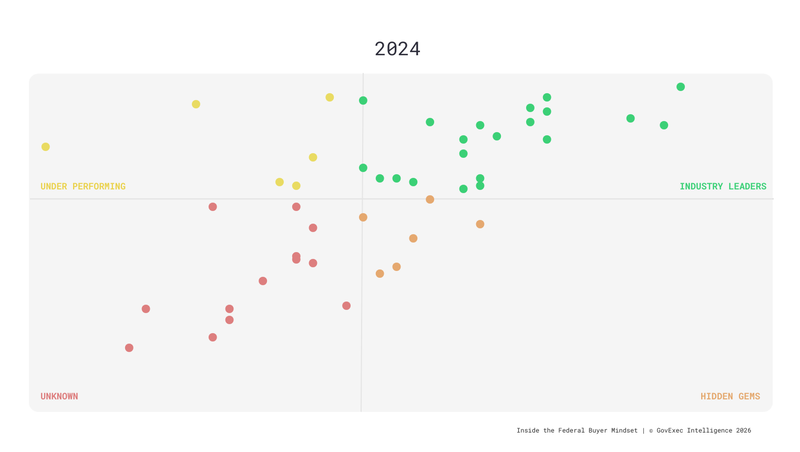
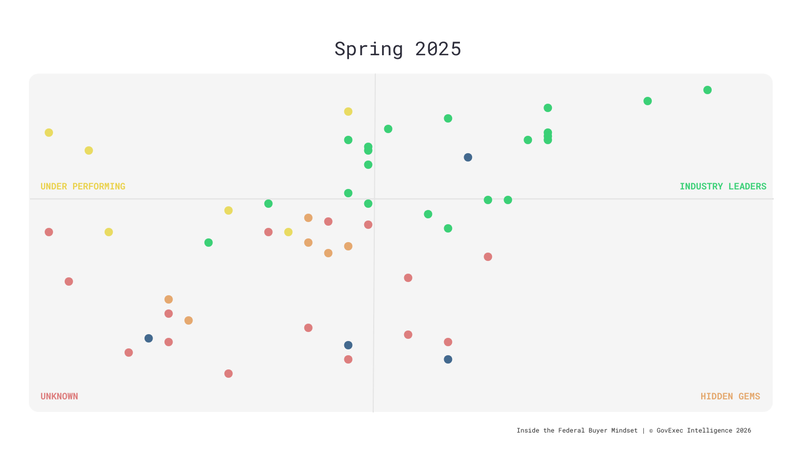
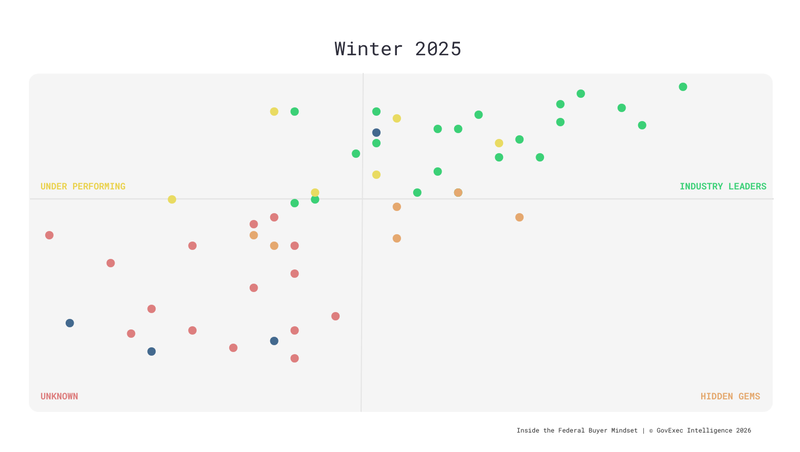
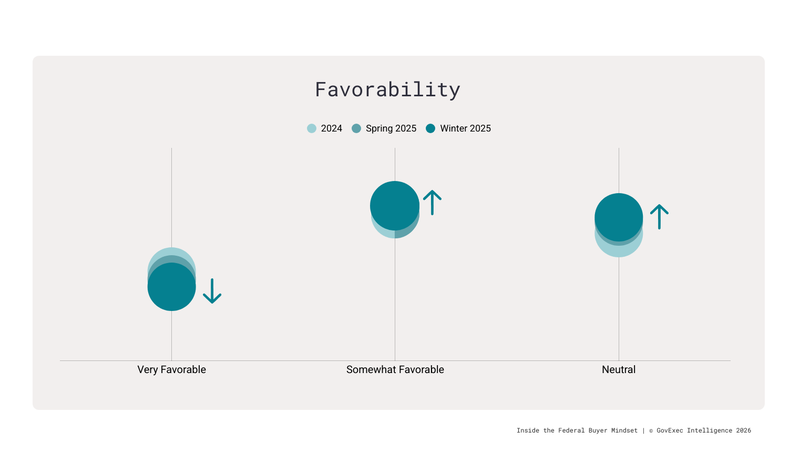
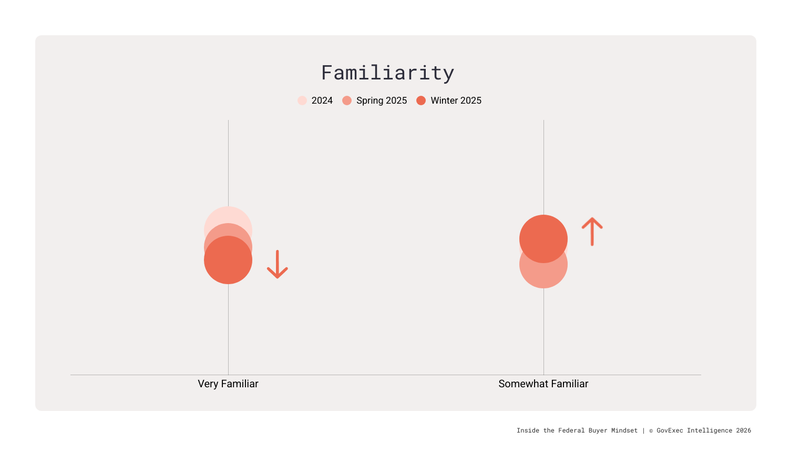
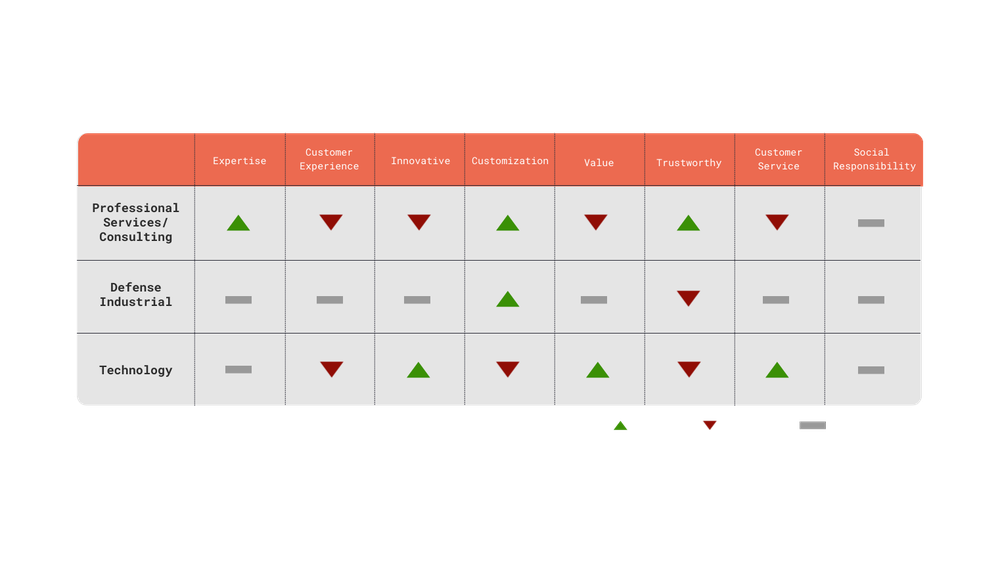
The attributes driving positive perception remain consistent:
- Trustworthiness
- Customer experience
- Expertise
- Innovation credibility
Professional services and defense firms focused on customer experience and delivery reliability tended to improve in those areas, even as broader sentiment remained mixed.
Improving trust requires deliberate engagement and validation. In other words, in a market where internal advocacy drives contract awards, companies must strengthen understanding at the account level, not simply expand top-line awareness.
Three Market Patterns Stand Out
1. Product companies have momentum.
Companies with clearly defined technology offerings (especially in AI, automation, and modern enterprise infrastructure) generally saw stronger familiarity gains than broad-based services firms.
When a company can articulate what they do in one sentence, it reduces buyer confusion and builds faster traction.
2. Alignment with administration priorities builds reputation.
Organizations that engaged constructively with pricing reform and acquisition modernization – rather than resisting it – saw reputational lift.
Proactive collaboration signaled adaptability. Buyers look for companies prepared to work within the environment as it exists today.
3. Commercial scale is now an asset.
For years, some federal buyers were skeptical of large commercial players entering the government market. However, now, commercial success is increasingly viewed as proof of stability, scalability, and innovation.
There has never been a greater appetite for commercial-grade solutions in the federal market.
The Rise of Strategic Boldness
One of the clearest takeaways from this year’s data is that companies that leaned into administration priorities gained more ground. Companies that bunkered down and opted to ride it out did not.
Boldness in this environment does not mean volume or provocation. It means:
- Proactively addressing pricing scrutiny.
- Publicly aligning product roadmaps with government modernization goals.
- Translating commercial AI breakthroughs into clear federal use cases.
- Engaging stakeholders across agencies and Capitol Hill with consistency.
Contractors who treated disruption as a platform instead of a threat created multiple opportunities. Pricing negotiations became proof points. New contract vehicles became launch moments. Policy shifts became positioning advantages.
In contrast, companies that opted for silence often drifted toward neutrality.
In government contracting, neutrality creates distance. Distance weakens preference.
The Alignment Imperative
Perhaps the most important differentiator we observed was internal alignment.
Organizations that showed consistency across leadership, marketing, business development, sales, and customer-facing teams were more effective at reinforcing their value proposition.
When a company introduces a new pricing model or a new technology focus, every touchpoint must convey the same message.
- Sales teams must articulate it clearly.
- Customer service teams must validate it through experience.
- Marketing must reinforce it consistently.
- Account teams must operationalize it.
When those pieces move together, trust strengthens. When they don’t, credibility erodes.
Our earlier research has shown that organizations with stronger marketing and sales alignment tend to see better recompete performance and stronger proposal outcomes. That finding carries even more weight in a market defined by uncertainty and speed.
Messaging Discipline Matters More in Volatility
Message volatility is expensive.
With AI breakthroughs, policy announcements, and acquisition reforms unfolding, some companies adjusted their positioning too often. Buyers noticed.
In a volatile market, stability in the value proposition becomes an advantage. Buyers need a durable narrative they can recognize and understand over time.
That doesn’t mean standing still. It means staying anchored while the environment changes around you.
- Grounding themselves in a durable core narrative
- Validating messaging before rollout.
- Translating commercial announcements clearly into government use cases.
- Avoiding reactive rebranding cycles.
The companies gaining momentum are those treating government strategy as an embedded component of product rollout.
The Federal Market is Fragmented, and Strategy Should Reflect That
The federal market is not a single audience. It is a collection of micro-markets shaped by different cultures, priorities, and stakeholders.
- Civilian vs. defense
- Agency-specific cultures
- Political appointee influence
- Capitol Hill engagement
- Contract vehicle dynamics
Interestingly, when we conducted a policy maker study in the summer of 2025, we observed that familiarity and favorability among some major contractors were stronger on Capitol Hill than within certain agencies – reinforcing the importance of stakeholder mapping.
No company should evaluate its brand solely at the aggregate level. Account-level diagnostics are now essential.
What Winning Contractors Are Doing Differently
Across segments, the most successful companies in 2025 shared five characteristics:
- They reintroduced themselves intentionally.
- They aligned internally before communicating externally.
- They leaned into reform rather than resisting it.
- They leveraged commercial credibility strategically.
- They maintained message consistency despite volatility.
Most importantly, they did not sit out the year.
Looking Ahead in 2026
If 2025 was the reset, 2026 is the acceleration phase.
Spending has resumed. Acquisition pathways are evolving. AI adoption is moving from experimentation to implementation. Buyers are settling into new roles and forming new perceptions.
The contractors best positioned for this environment will treat perception as a competitive asset. That means measuring it, managing it, and continuously reinforcing it.
Visibility on its own is not enough. Trust has to be supported by clarity. Clarity has to be supported by alignment.
Federal buyers are recalibrating. Contractors should be doing the same.
Understanding your market position is the first step. Advancing it is the next. Connect with our team to see how GovExec Intelligence and activation strategies can help you do both.
Watch Inside the Federal Buyer Mindset for a closer read on our survey data.
 6 minutes