3 minutes
In government, events have long served as early entry points in the acquisition process, giving leaders visibility into emerging solutions and contractors crucial face time. But this year, the conditions shaping who attends, why they attend, and what they expect from events are changing.
An environment in flux
Following the Trump administration’s return-to-office mandate, interest in live engagement is rebounding. At the same time, however, new workforce constraints, budget scrutiny that limits registration approvals, and rising expectations for measurable outcomes are narrowing the window for participation.
Government employees are no longer able to attend multiple events. Instead, they are prioritizing fewer, more consequential moments, leading to a significant market shift: Away from volume. Toward precision.
“What has changed is that people are coming out with more intention,” said Casey Stankus, Senior Director of Event Operations and Business Development at GovExec, during a panel at GovExec’s Market Preview. “They’re looking to make the connections, they’re looking to take those key takeaways back to their agencies to say, ‘This was worthwhile for my attendance.’”
Hybrid and virtual components continue to play an important supporting role in extending reach and accessibility, allowing agencies and industry to convene without requiring travel.
Bottom line: Touchpoints with government decision-makers are becoming more limited. Make them count. Access without substance ends when people leave the room. Access shaped with intention creates relevance that carries forward.
Mission focus is driving participation
The strongest opportunities now sit at the intersection of agency need and industry expertise. Topic-driven conferences consistently draw the biggest crowds because they are designed around why people are in the room
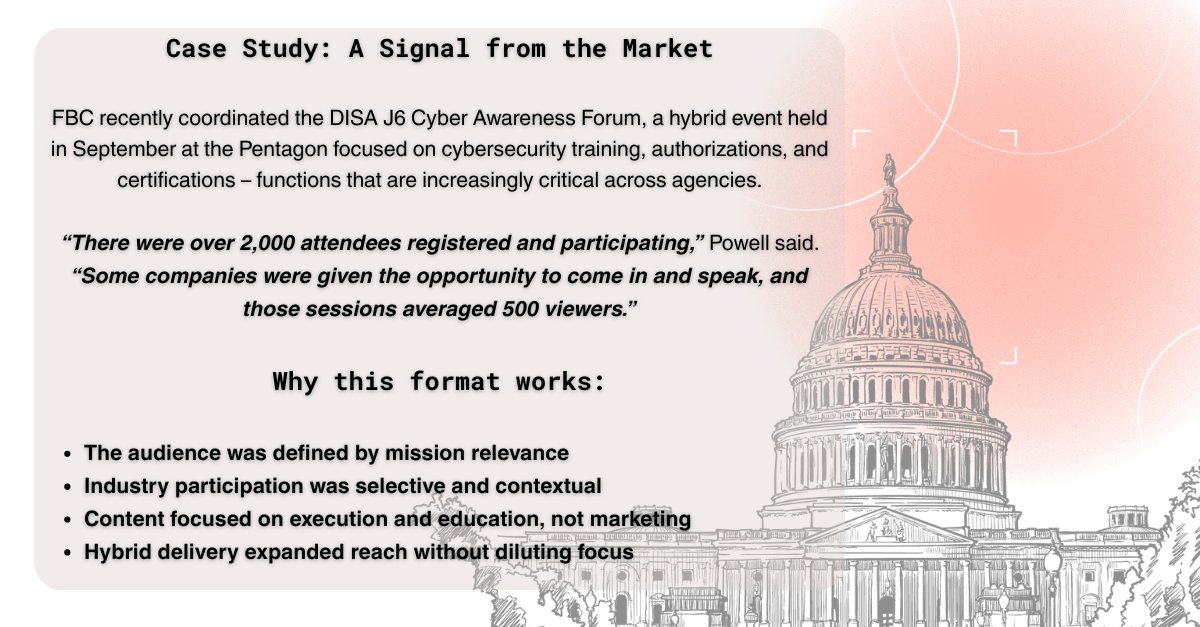
Consequently, “it almost becomes a required event for the target audience,” said David Powell, Chief Executive Officer of the Federal Business Council (FBC), which works directly with agencies planning events to determine which industry partners are best suited to participate.
“Government knows that it doesn’t create or manufacture anything itself. It needs industry to do what it does,” he explained. “The agencies that we work with want us to reach out to industry and bring in organizations that have the ability to help them accomplish what they’re there to accomplish.”